Wednesday, April 3, 2013

10 Little-Known Mysterious Ghost Types

10 Little-Known Mysterious Ghost Types

By Johnny Peters March 27 2013

Nowadays, ghosts and spirits are all the rage in popular culture. Every channel you flip on, there seems to be a plethora of ghost based shows. There are reality shows—“Ghost Hunters,” “Ghost Travelers,” “Celebrity Ghost Stories,” “Ghost Hunters Academy” and even dramas based on the subject, such as “Ghost Whisperer” and “Being Human,” among others. In these shows, you have the typical paranormal phenomena being showcased, like full body apparitions, orbs, shadow people, EVPs, phantoms, poltergeists—in other words, all the usual suspects.
They get spoken about so much, the everyday person, whether skeptic or believer, is familiar with these classifications of ghosts. Unfortunately, while these ghost types get all of the love and hype, some of their lesser known brethren get tossed to the wayside. The following ghost types in this list may not be glamorous, but that doesn’t make them any less mysterious or scary, in my opinion. So let us begin down this hall of unknown spooks.
Crowd Demon
Crowd
Crowd demons are very strange anomalies. While demons seem to not be restricted or constrained by time and location, crowd demons seem to specifically show up in places that are inhabited by large groups of people, hence the term crowd in their name. Why crowd demons are attracted to crowds, there are no concrete answers. Theories range from energy emanated by the specific location, or an attraction to the photographer or bystander in the crowd. Standard apparitions may make singular appearances on film, but crowd demons tend to show up in numbers.
When they do appear on film, crowd demons may take on various distorted shapes, some nearly unrecognizable to the human eye. One picture (shown above), shows what looks like a reptile shaped head biting down on the person standing next to it, while in the same picture, a darkened outline of a person sits among the onlookers, conspicuously standing out from the live members of the audience. Next to this figure, there seems to be a distorted face looking back at the camera. Perhaps these spirits arrive in numbers and among throngs of people because they are desperate to get noticed?
Animal Ghosts
Ghost-Dog
Animals are some of the most beloved members of families units, but somehow, after the pets pass on, their spirits get neglected. Professional ghost hunters, when they are one of their many sojourns, rarely seek out these nimble ghosts, opting instead for the sexier shadow people and poltergeists. Animal ghosts have been reported in many cases, yet they are overlooked. The infamous Bell Witch haunting, which plagued the family of John William Bell in the early 1800s, had reports of animal ghosts, such as phantom birds and vanishing dogs. Again though, in the case of these hauntings, the animal ghosts are just mere accessories to the more heavyweight phantoms. Animal ghosts make their presence felt not just in manifestations, but also sound and smell. It is not unusual for a person experiencing a haunting which includes animal ghosts to hear the pitter patter of the invisible animal, or whimpering, panting and scratching on the walls and doors.
Vortex
2275289261 99C3A0B74B O
The vortex is a supernatural phenomenon that the average layperson in the field of the paranormal may have not heard of and understandably so, as the vortex is a strange being indeed. It is unobservable to the normal human eye, usually showing its presence only in picture stills. The vortex is long—usually in the shape of a cigar or a metal rod—and contains a thread like design, making them appear almost like a turning screw in mid air. Vortexes make themselves known through temperature, making the immediate area they occupy cold. The vortex can be mistaken as the more common orb, as they both are travel in similar trajectories. The vortex is more of an indoor phenomenon, and like other types of paranormal objects, are usually attached to larger scale hauntings. Since they seem to solely exist within the confines of homes, there is the theory that they may be previous residents of the property. They may actually be vehicles for other spirits to piggy back on as they travel between their dimension and ours.
Inanimate Ghosts
Tumblr Lj8Tghkf6P1Qiav96O1 1280
At one time, inanimate ghosts were all the rage in the ghost scene. The phantom ship, the Flying Dutchman, personifies what the inanimate ghost is all about. The Flying Dutchman terrorized sailors on the high seas in the 17th century, so much so that even gazing upon it meant almost certain doom for the voyage. The Flying Dutchman, apart from the most ardent of enthusiasts and opera buffs, is largely forgotten in this day and age, and no longer inspires the fear that it once did. Inanimate ghosts come in all forms, not just ships. They can be cars, trains, and even disembodied lamps. One thing that all inanimate ghosts have in common is routine; they all appear in the same time and place, traveling the same routes the vehicle (if it is a moving thing) was taking right as the moment of disaster. These ghosts are frozen in time, repeating their final moments, over and over again, without any hope of liberation from their perpetual cycle.
Doppelgänger
Heres-Nic-Cage-And-His-Doppelganger-Little-Is-Known-About-The-Man-Besides-That-He-Supposedly-Served-In-The-Civil-War
The “Doppelgänger” is unique among other ghosts. The definition of this type of ghost is actually found in the name. “Doppelgänger” is a German word for “double goer.” This ghost type has the ability to project itself in more than one place, hence the meaning of its name. As far as is known, no other ghost type has this kind of ability. But the real unique quality of the doppelgänger is that the person it projects to others can still be alive. So it is entirely possible that a person can see their loved one when they are not physically present. Another common scenario involving the doppelgänger is a person seeing the image of someone close to them, only to find out later that the person they saw died at the precise moment their image appeared. The mythos of the doppelgänger is that it precedes some kind of tragedy. American President Abraham Lincoln claimed to have seen his own doppelgänger in a mirror right before he was assassinated, and poet Percy Bysshe Shelley saw his in a dream. No one knows for sure what a doppelgänger really is. Theories persist, but indicative of the paranormal, there is no certified conclusion. Doppelgängers may be astral projections of live persons or the actual spirit of the person, recently departed and visiting those important in its life.
Kobold
Gef Sanctum
Unless one is German, then the “Kobold” is not exactly a household term when it comes to the paranormal. Like a poltergeist, the kobold is a mischievous little spirit, playing tricks on humans and doing things to unsettle whoever is occupying its space. Kobolds can be malevolent or benevolent, depending on circumstances. Very chameleon like, the kobold may materialize in various forms, whether it be an animal or an element, such as fire. The weird case of Gef the talking mongoose personified the kobold. The story began in 1931, near Dalby, in the Isle of Man. In September of that year, the Irving family began to hear what sounded like and animal scratching behind the walls in their farmhouse. Eventually, it began to make animal sounds and making baby sounds as well. Soon, the entity introduced itself as Gef, a mongoose. Gef over time claimed to be an earthbound spirit in the form of a mongoose, which apparently was verified by the 13 year old daughter of James Irving, Voirrey, who was the only one to see Gef. She described Gef as a yellow rat like creature, with a bushy tail. Gef was friendly towards the Irvings, but was not above being naughty with visitors. Gef would throw things at people and spy on the Irving’s neighbors. To this day, the story of Gef has not been solved and is largely forgotten about.
Lemurs
Ghostz-Ganmed64-Flickr-E1319772433976
Lemurs have their roots in ancient Roman times. These ghosts were so important to the Romans that a whole mythos was built around them. The lemur was known as a malignant entity. A wandering type of ghost, it is said to carry anger and hostility over having its earthly life cut short and not having the proper funeral rites given. Also a lemur can be the ghost of a person who had died without the benefit of a family. Basically, the lemur is a very angry wandering ghost. As in the example of the doppelgängers, the lemur is often associated with darkness, doom and misfortune. The fear was so great in encountering a lemur that the ancient Romans set aside certain days in the month of May to appease these ghosts. This was known as Lemuralia. But when we strip away the allure of ancient Roman mythology, the lemur just seems to be a combination of anapparition and a phantom, and yes, before you ask, there are differences between the two. But we in the present are far removed from the ancient Roman era, so with the disappearance of time, the lemur has disappeared from our minds.
Etheric Revenants
Screen Shot 2013-03-27 At 6.44.16 Am
We may have read stories or even seen shows where people become weak and lose energy being in certain haunted places. This probably can be attributed to the presence of an etheric revenant. These types of ghosts are admittedly very rare. They possess qualities that would suggest that they are somewhat linked to non-earthly entities, such as demons or beings from another dimension, as they have an appearance which is very similar to the more common “Shadow People” ghost type. But unlike the shadow people, the etheric revenant primarily siphons energy away from any living being in the areas that they inhabit. Etheric revenants are considered highly dangerous, as they take a physical and emotional toll on its victims. But despite their highly dangerous position in the hierarchy of ghosts, you will hardly ever hear anyone, especially in mainstream media, speak of these creatures.
Residual Historical Haunting
Moberly1
This type of haunting is extremely rare, hardly gets any mention and is something that most humans will never experience. First, let us establish what a residual haunting is. A residual haunting, in layman’s terms, is like a recorded tape, which you can rewind and forward, to play the same snippet over and over again, in a loop. In a residual haunting, the apparition is on loop, doing the same things over and over again. They may even do these things at certain times, which explain why some hauntings seem to be triggered or heightened at specific times of the day. Well, a residual historical haunting is a regular residual, but amplified to the tenth degree, usually involving multiple apparitions and whole scenes out of history replaying itself. One of the most famous cases of a residual historical haunting is the “Versailles Time Slip.” This occurred in August of 1901, while Charlotte Anne Moberly and Eleanor Jourdain were touring Versailles. They both experienced intense feelings, then they discover themselves walking among people dressed like they were in 18th century Paris. Everything seemed to turn unworldly at this point and Moberly even thought she witnessed Marie Antoinette, sitting on the grass, sketching. It was over as quickly as it started.
Artificial Ghost
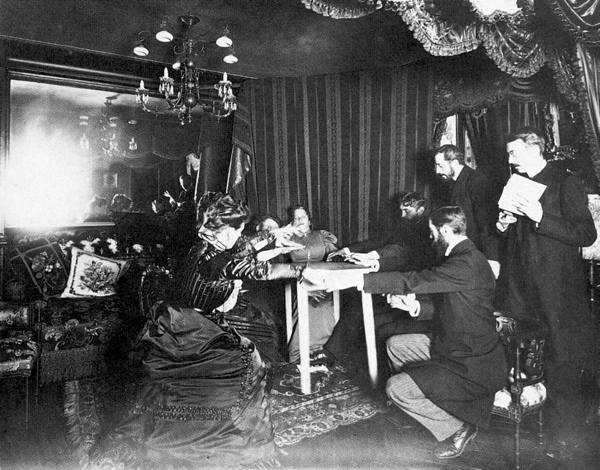
Seance
The artificial ghost is among the rarest of ghost types on this list and in the whole pantheon of the spirit world. It is basically a ghost that is created from the ground up. A customized ghost is, if you will, like a group of kids creating a video game character in their favorite game and playing out the story with that character. This is how it happens. A group of people come together and virtually creates a name for their ghost, plus a narrative for said ghost. Then afterwards, this group combines all of their mental and spiritual energies, sometimes with the assistance of tools, such as Ouija boards, in their endeavor of creation. And just like that, bingo, you have your own, personal ghost. Now this may sound like a joke, but actual serious research and experimentation was put into this. One such experiment by the Toronto Society for Psychical Research, was illustrated in a book, entitled, Conjuring Up Philip: An Adventure in Psychokineses. The book details the group’s creation of an entity named Phillip using psychokinesis . The results were startling. Not only was an entity named Phillip created, but they were able to communicate with the freshly created ghost using raps and knocks, plus they attained the power of levitation. Well—that’s what they said. They went on later to create Lilith (a Canadian spy) and Sebastian (a medieval alchemist).


Tuesday, April 2, 2013

Digital Recorders vs. Analog Tape Recorders

              Digital Recorders vs. Analog Tape Recorders

To Buy Or Not To Buy a Digital Recorder – 7 Features to Consider

Digital Recorders
Analog tape recording devices have been around for decades and still play an important role in dictation and transcription.
In recent years, however, you’ve probably seen more digital recorders in the pockets and on the desks of everyone from students and office assistants to doctors, lawyers, and board chairmen.
Is it worth upgrading from analog microcassettes to digital smart cards? Will you be able to figure out how to use it? And will you be able to afford it?
7 features to consider when considering Digital vs. Analog Recorders
1. PORTABILITY.  Technology has advanced to the point where digital recorders are as small and light, if not smaller and lighter, than microcassette recorders, so you’ll be able to take them anywhere you need them. By the way, these digital recorders are great gifts for people on the go.
2. RECORDING MEDIA .  Digital recorders use either internal flash memory or smart cards, which can be inserted and ejected like cassettes, to record. Both options give you anywhere from dozens to hundreds of hours of recording time, even on the smallest digital devices. When you’ve run out of recording room, you can simply transfer the files to your computer and erase them from the recorder. If you’re using a recording device with smart cards, you can simply buy a new one, pop it in the recorder and go.
3. DURABILITY. Analog recorders are rugged and long-lasting. Contrary to what you might think, so are digital recorders. In fact, because they have no moving parts, they’re built to last for years with virtually no wear and tear. Same goes for the smart cards which many digital recorders employ. All the information is stored on chips in the smart card, so there’s nothing to rewind or fast-forward when you’re looking for a specific part of the recording. As a result, it’s virtually impossible (pun intended) for a smart card to wear out.
4. STORING AND SHARING RECORDINGS.  Digital recorders connect directly to your computer – many of them don’t even require a USB cord – so you can transfer files to your hard drive quickly and easily. This makes it a snap to flexibily organize your files, and it also makes it much easier to send files to multiple users via email. Have a long meeting you want transcribed by more than one person at the same time? Simply transfer the recording from your digital recorder to your computer and send it off to all the transcribers simultaneously. If you want a hard copy, just burn the file/files to a CD.
5. EASE OF USE. Recording digitally makes it easier to find a specific part of your sound file. No more rewinding and fast-forwarding! If you want to hear something that was said half an hour or two hours or five hours into your meeting, you can access it in seconds. You can even extract the important parts of a long recording and make separate files for them. And it’s practically unheard of to mistakenly erase a sound file. Unlike an analog cassette, you can’t simply rewind a digital file and accidentally record over it – erasing it takes deliberate effort.
6. ENGINEERING. It’s nearly impossible to mess up a digital recording. Depending on your budget, you can purchase a recorder which will automatically set recording levels. Many digital recorders can also record only when sound is detected. That way, if you’re recording a seminar or meeting with a lot of long pauses, you won’t have a lot of “dead air” on your recording.
7. PRICE.  Analog tape recorders still have a price advantage at the lower end of the market, but as you add bells and whistles, there’s a wide range of digital recorders available at competitive prices. The time has arrived when state-of-the-art digital recording technology is within the reach of everyone from students to executives.  
Take a look at our selection of digital voice recorders and see which one is right for your needs and your budget! Or if you are a particular fan of Olympus, see our review of current Olympus recorders.

Ghost Hunting Tips & Rules

ghost hunters home
Ghost Hunting Tips & Rules

  • Never go ghost hunting alone.
  • Always let someone know where you will be.
  • Always carry id.
  • If you feel uncomfortable, leave!
  • Get permission before going onto private property or to be in a cemetery after hours.
  • Reschedule your ghost hunt if it is going to snow, rain, or if it is foggy. Also check the pollen count. Moisture and pollen can cause anomalies in photos.
  • If you have a large group break up into pairs or smaller groups.
  • Carry walkie talkies or cell phones. You never know when you might need them.  
  • Don't use drugs or alcohol before or during an investigation or hunt.
  • Don't smoke near where you will be investigating. Make a designated spot for smoking. You don't want to photograph smoke and think it is an ecto mist or spirit. 
  • When trying to record evps never whisper.  Talk in a normal voice. You won't scare the ghosts if you talk. And you don't want to mistake a human whisper for a spirit.
  • Always use new tapes in the recorder.
  • Have extra batteries and make sure all equipment is fully charged.
  • Wear a watch so you can note times of events.
  • Wear clothing suited for the weather and always wear comfortable shoes.
  • Don't wear jackets with strings. The strings could get in the way when taking photos and be mistaken for something paranormal, especially if you are shooting downward.
  • Don't wear perfume or cologne while ghost hunting. If using an insect repellent make sure it is unscented. Some have noticed scents or smells when there is reported ghost activity. Perfumes may mask these scents.
  • Tie back long hair. When a piece of hair gets in front of the camera lens it will look like a vortex.
  • Remove camera straps or be aware where they are when taking a photo. Many times straps get in the picture and can be mistaken for a vortex, ecto, moving orb and ghosts.
  • Look for things in the way like spiderwebs, wire, ropes, tree limbs. They can appear on photos as something paranormal when they are in close range of the camera lens.
  • Always clean camera lenses. Lint, dust specks, smudges and fingerprints can look like ecto mist, orbs, and other ghostly anomalies.
  • Be aware of the temperature when photographing outdoors or in an unheated building. Hold your breath while taking a photo and for several seconds afterward. Remember, if you can see it so can the camera.
  • Always know where your fingers are when taking photos. A thumb or finger can appear to be a ghost when caught in front of the lens. It is a big let down to find out it's not paranormal after all.
  • Research the location. If you are going ghost hunting after dark, you should check it out during daylight hours. Make note of any dangers such as holes, broken glass, loose boards etc.
  • Be objective of your findings. Rule out any natural causes that may have caused anomalies such as insects, lights in the distance, spider webs, reflections.  


Mothman

                      Mothman

Mothman is a legendary creature first reportedly seen in the Point Pleasant area of West Virginia from 15 November 1966 to 15 December 1967. The first newspaper report was published in the Point Pleasant Register dated 16 November 1966, entitled "Couples See Man-Sized Bird...Creature...Something".[1]
Mothman was introduced to a wider audience by Gray Barker in 1970,[2][3] later popularized by John Keel in his 1975 book The Mothman Prophecies, claiming that Mothman was related to a wide array of supernatural events in the area and the collapse of the Silver Bridge. The 2002 film The Mothman Prophecies, starring Richard Gere, was based on Keel's book.[4]

History

On Nov. 12, 1966, five men who were digging a grave at a cemetery near Clendenin, WV claimed to see a man-like figure fly low from the trees over their heads [5]. This is often attributed as the first known sighting of what would become known as the Mothman.
Shortly thereafter, on Nov. 15, 1966, two young couples from Point Pleasant, Roger and Linda Scarberry, and Steve and Mary Mallette told police they saw a large white creature whose eyes "glowed red" when the car headlights picked it up. They described it as a "flying man with ten foot wings' following their car while they were driving in an area of town known as 'the TNT area', the site of a former World War II munitions plant.[6][7]
During the next few days, other people reported similar sightings. Two volunteer firemen who sighted it said it was a "large bird with red eyes". Mason County Sheriff George Johnson commented that he believed the sightings were due to an unusually large heron he termed a "shitepoke". Contractor Newell Partridge told Johnson that when he aimed a flashlight at a creature in a nearby field its eyes glowed "like bicycle reflectors", and blamed buzzing noises from his television set and the disappearance of his German Shepherd dog on the creature.[8] Wildlife biologist Dr. Robert L. Smith at West Virginia University told reporters that descriptions and sightings all fit the Sandhill Crane, a large American crane almost as high as a man with a seven foot wingspan featuring circles of reddish coloring around the eyes, and that the bird may have wandered out of its migration route.
There were no Mothman reports in the immediate aftermath of the December 15, 1967 collapse of the Silver Bridge and the death of 46 people [9], giving rise to legends that the Mothman sightings and the bridge collapse were connected.[8][10][11]

[edit]Claims of later sightings

UFOlogist Jerome Clark writes that many years after the initial events, members of the Ohio UFO Investigators League re-interviewed several people who claimed to have seen Mothman, all of whom insisted their stories were accurate. Linda Scarberry claimed that she and her husband had seen Mothman "hundreds of times, " sometimes at close range, commenting, "It seems like it doesn’t want to hurt you. It just wants to communicate with you. "[12]
Cryptozoologist Loren Coleman claims that sightings of Mothman continue, and told USA Today he re-interviewed witnesses described in Keel's book who said Mothman was "a huge creature about 7 feet tall with huge wings and red eyes" and that "they could see the creature flapping right behind them" as they fled from it.[13]

[edit]Explanations

[edit]Paranormal

Some UFologistsparanormal authors, and cryptozoologists believe that Mothman was an alien, a supernatural manifestation, or an unknown cryptid. In his 1975 book The Mothman Prophecies, author John Keel claimed that the Point Pleasant residents experienced precognitions including premonitions of the collapse of the Silver Bridge, unidentified flying object sightings, visits from mysterious or threatening men in black, and other bizarre phenomena. However, Keel has been criticized for distorting established data, and for gullibility.[12]

[edit]Skeptical

Skeptic Joe Nickell says that a number of hoaxes followed the publicity generated by the original reports, such as a group of construction workers who tied red flashlights to helium balloons. Nickell attributes the Mothman reports to pranks, misidentified planes, and sightings of a barred owl, an albino owl, suggesting that the Mothman's "glowing eyes" were actually red-eye effectcaused from the reflection of light from flashlights or other bright light sources. The area lies outside the snowy owl's usual range and locals, unfamiliar with such a large owl, could have misidentified the bird. [6]
Folklorist Jan Harold Brunvand notes that Mothman has been widely covered in the popular press, some claiming sightings connected with UFOs, and others claiming that a military storage site was Mothman's "home". Brunvand notes that recountings of the 1966-67 Mothman reports usually state that at least 100 people saw Mothman with many more "afraid to report their sightings", but observed that written sources for such stories consisted of children's books or sensationalized or undocumented accounts that fail to quote identifiable persons. Brunvand found elements in common among many Mothman reports and much older folk tales, suggesting that something real may have triggered the scares and became woven with existing folklore. He also records anecdotal tales of Mothman supposedly attacking the roofs of parked cars inhabited by teenagers.[14]

[edit]Festivals and statue

Point Pleasant held its first Annual Mothman Festival in 2002 and a 12-foot-tall metallic statue of the creature, created by artist and sculptor Bob Roach, was unveiled in 2003. The Mothman Museum and Research Center opened in 2005 and is run by Jeff Wamsley.[15][16][17] The Festival is a weekend-long event held on the 3rd weekend of every September. There are a variety of events that go on during the festival such as guest speakers, vendor exhibits, and hayride tours focusing on the notable areas of Point Pleasant.[10]

[edit]Popular culture

  • In Season 5, Episode 4 of The X-FilesDetour, Agent Mulder hypothesizes that the supernatural events occurring may be related to the creature. However, Mulder refers to a group of creatures called the Mothmen as opposed to a singular Mothman.
  • In Episode 2 of the short-lived TV series X-Testers, the researchers attempted to duplicate alleged photographs of Mothman.[18]
  • The Luminoth, a tribe of mothlike humanoid creatures appearing in Metroid Prime 2: Echoes for the Nintendo Gamecube may also considered to be some kind of mothmen.
  • In the video game Castlevania: Dawn of Sorrow, Mothman is one of three Cryptozoology-based monsters along with the Yeti and the Flying Humanoid. It also appears again as an enemy inCastlevania: Portrait of Ruin.
  • In the Shin Megami Tensei series of video games, Mothman often appears as a demon that the main characters can use as an ally.
  • Mothman appears in an episode of Lost Tapes.
  • Mothman is the alias of Byron Lewis in Alan Moore's graphic novel Watchmen.
  • On the television show Invader Zim the character Dib is a member of a clandestine organization called The Swollen Eye where his code name is "Mothman".
  • In the game GTA: San Andreas, the Mothman is said to be located in the desert.

Jersey Devil

                   Jersey Devil

Jersey Devil
(Leeds Devil)
Jersey Devil Philadelphia Post 1909.jpg

The Jersey Devil,
Philadelphia Evening Bulletin, January 1909.
Data
First reportedNative American folklore
CountryUnited States
RegionPine Barrens (New Jersey)
The Jersey Devil is a legendary creature or cryptid said to inhabit the Pine Barrens of Southern New Jersey, United States. The creature is often described as a flying biped with hooves, but there are many different variations. The most common description is that of a kangaroo-like creature with the head of a goat, leathery bat-like wings, horns, small arms with clawed hands, cloven hooves and a forked tail. It has been reported to move quickly and often is described as emitting a "blood-curdling scream."[1][2]
The Jersey Devil has worked its way into the pop culture of the area, even lending its name to New Jersey's team in the National Hockey League, and appeared on an early episode of The X-Files.

Contents

  [hide

[edit]Origin of the legend

There are many possible origins of the Jersey Devil legend. The earliest legends date back to Native American folklore. The Lenni Lenape tribes called the area around Pine Barrens "Popuessing", meaning "place of the dragon".[3] Swedish explorers later named it "Drake Kill", "drake" being a Swedish word for dragon, and "kil" meaning channel or arm of the sea (river, stream, etc.)[4]
The most accepted origin of the story, as far as New Jerseyans are concerned, started with Mother Leeds and is as follows:
"It was said that Mother Leeds had 12 children and, after finding she was pregnant for the 13th time, stated that this one would be the Devil. In 1735, Mother Leeds was in labor on a stormy night. Gathered around her were her friends. Mother Leeds was supposedly a witch and the child's father was the Devil himself. The child was born normal, but then changed form. It changed from a normal baby to a creature with hooves, a goat's head, bat wings and a forked tail. It growled and screamed, then killed the midwife before flying up the chimney. It circled the villages and headed toward the pines. In 1740 a clergy exorcised the demon for 100 years and it wasn't seen again until 1890."
"Mother Leeds" has been identified by some as Deborah Leeds.[5] This identification may have gained credence from the fact that Deborah Leeds' husband, Japhet Leeds, named twelve children in the will he wrote in 1736,[6] which is compatible with the legend of the Jersey Devil being the thirteenth child born by Mother Leeds. Deborah and Japhet Leeds also lived in the Leeds Point section of what is now Atlantic County, New Jersey,[7] which is the area commonly said to be the location of the Jersey Devil story.

[edit]Reported encounters

There have been many sightings and occurrences allegedly involving the Jersey Devil.
According to legend, while visiting the Hanover Mill Works to inspect his cannonballs being forged, Commodore Stephen Decatur sighted a flying creature flapping its wings and fired a cannonball directly upon it to no effect.[8]
Joseph Bonaparte, eldest brother of Emperor Napoleon, is also said to have witnessed the Jersey Devil while hunting on his Bordentown estate around 1820.[8] In 1840, the devil was blamed for several livestock killings. Similar attacks were reported in 1841, accompanied by tracks and screams.
Claims of a corpse matching the Leeds Devil's description arose in Greenwich in December 1925. A local farmer shot an unidentified animal as it attempted to steal his chickens. Afterward, he claimed that none of 100 people he showed it to could identify it.[9] On July 27, 1937 an unknown animal "with red eyes" seen by residents of Downingtown, Pennsylvania was compared to the Jersey Devil by a reporter for the Pennsylvania Bulletin.[10] In 1951, a group of Gibbstown, New Jersey boys claimed to have seen a 'monster' matching the Devil's description.[11] and claims of a corpse matching the Jersey Devil's description arose in 1957.[12] In 1960, tracks and noises heard near Mays Landing were claimed to be from the Jersey Devil.[13] During the same year the merchants around Camden offered a $10,000 reward for the capture of the Jersey Devil, even offering to build a private zoo to house the creature if captured.[14]

[edit]Sightings of 1909

During the week of January 16 through 23, 1909, newspapers of the time published hundreds of claimed encounters with the Jersey Devil from all over the state. Among alleged encounters publicized that week were claims the creature "attacked" a trolley car in Haddon Heights and a social club in Camden.[15] Police in Camden and Bristol, Pennsylvania supposedly fired on the creature to no effect.[16] Other reports initially concerned unidentified footprints in the snow, but soon sightings of creatures resembling the Jersey Devil were being reported throughout South Jersey and as far away as Delaware.[17] The widespread newspaper coverage led to a panic throughout the Delaware Valley prompting a number of schools to close and workers to stay home. During this period, it is rumored that the Philadelphia Zoo posted a $10,000 reward for the creature's capture. The offer prompted a variety of hoaxes, including a kangaroo with artificial wings.[18]

[edit]Explanations

Skeptics believe the Jersey Devil to be nothing more than a creative manifestation of the English settlers, Bogeyman stories created and told by bored Pine Barren residents as a form of children's entertainment, and rumors arising from negative perceptions of the local population ("pineys"). According to Brian Dunning of Skeptoid, folk tales of the Jersey Devil prior to 1909 calling it the "Leeds Devil" may have been created to discredit local politician Daniel Leeds who served as deputy to the colonial governor of New York and New Jersey in the 1700s.[19] Folklorist Jan Harold Brunvand wrote that the spread of contemporary pop culture has overtaken traditional Jersey Devil legends.[20] Jeff Brunner of the Humane Society of New Jersey thinks the Sandhill Crane is the basis of the Jersey Devil stories, adding, "There are no photographs, no bones, no hard evidence whatsoever, and worst of all, no explanation of its origins that doesn't require belief in the supernatural."[21] Outdoorsman and author Tom Brown, Jr. spent several seasons living in the wilderness of the Pine Barrens. He recounts occasions when terrified hikers mistook him for the Jersey Devil, after he covered his whole body with mud to repel mosquitoes.
One New Jersey group called the "Devil Hunters" refer to themselves as “official researchers of the Jersey Devil", and devote time to collecting reports, visiting historic sites, and going on nocturnal hunts in the Pine Barrens in order to "find proof that the Jersey Devil does in fact exist."[22]

[edit]Popular culture

The Jersey Devil has become a cultural icon in the state, inspiring several organizations to use the nickname. In professional hockey, the Eastern Hockey League Jersey Devils played from 1964 through 1973. When the National Hockey League Colorado Rockies relocated to New Jersey in 1982, a fan poll voted to rename that team the New Jersey Devils.[23][24]
The New Jersey Air National Guard's 177th Fighter Wing, stationed at the FAA William J. Hughes Technical Center within the Pine Barrens, is also nicknamed the Jersey Devils.[25]
American professional wrestler, Jason Danvers, portrays a character called "The Jersey Devil", a psychopathic member of a stable called "The Asylum". His outfit consists of a black and white wrestling singlet, long tights, and boots. He also wears full facepaint of a white face covering with black make-up over it that gives him horns and a "Joker"-esque, evil smile. He wrestles for WAW wrestling in Manchester, NH.[26]