An out of body experience may also be referred to as astral projection or astral travel. Abbreviated names for out of body experiences are OOBE and OBE.
Some people can self-induce an out of body experience by using visualization and meditation techniques. Other out of body experiences happen involuntarily, often to the amazement of the experiencer. Many people report a sensation of floating near the ceiling or flying, and the ability to see their physical body below them. Out of body experiences are unlike dreams in that they feel very real, happening in the here and now physical world. Experiencers report they remember the event clearly and vividly even years afterwards.
Out of body experiences are distinguished from near death experiences by one important feature. Although a near death experience may have an out of body component, such as looking down on your body before continuing on, an out of body experience does not include the belief or fact of being clinically dead before returning to the body.
If you're unsure where to start reading, try the Editor's recommendations below. If you've had an out of body experience, send it to us for inclusion.
Definition of an out of body experience
An experience of having left the confines of one's physical body and observing the world from a point other than where the physical body is located.
How to have an out of body experience
If you want to learn more about how to have an out of body experience be sure to check out our how to have an out of body experience page. There are tips and hints and two visualization exercises to get you started. Good luck and don't forget to come back here and tell us about your astral travels!
NVDs have been around for more than 40 years. They are categorized by generation. Each substantial change in NVD technology establishes a new generation.
Generation 0 - The original night-vision system created by the United States Army and used in World War II and the Korean War, these NVDs use active infrared. This means that a projection unit, called an IR Illuminator, is attached to the NVD. The unit projects a beam of near-infrared light, similar to the beam of a normal flashlight. Invisible to the naked eye, this beam reflects off objects and bounces back to the lens of the NVD. These systems use an anode in conjunction with the cathode to accelerate the electrons. The problem with that approach is that the acceleration of the electrons distorts the image and greatly decreases the life of the tube. Another major problem with this technology in its original military use was that it was quickly duplicated by hostile nations, which allowed enemy soldiers to use their own NVDs to see the infrared beam projected by the device.
Generation 1 - The next generation of NVDs moved away from active infrared, using passive infraredinstead. Once dubbed Starlight by the U.S. Army, these NVDs use ambient light provided by the moon and stars to augment the normal amounts of reflected infrared in the environment. This means that they did not require a source of projected infrared light. This also means that they do not work very well on cloudy or moonless nights. Generation-1 NVDs use the same image-intensifier tube technology as Generation 0, with both cathode and anode, so image distortion and short tube life are still a problem.
Generation 2 - Major improvements in image-intensifier tubes resulted in Generation-2 NVDs. They offer improved resolution and performance over Generation-1 devices, and are considerably more reliable. The biggest gain in Generation 2 is the ability to see in extremely low light conditions, such as a moonless night. This increased sensitivity is due to the addition of the microchannel plate to the image-intensifier tube. Since the MCP actually increases the number of electrons instead of just accelerating the original ones, the images are significantly less distorted and brighter than earlier-generation NVDs.
Generation 3 - Generation 3 is currently used by the U.S. military. While there are no substantial changes in the underlying technology from Generation 2, these NVDs have even better resolution and sensitivity. This is because the photo cathode is made using gallium arsenide, which is very efficient at converting photons to electrons. Additionally, the MCP is coated with an ion barrier, which dramatically increases the life of the tube.
Generation 4 - What is generally known as Generation 4 or "filmless and gated" technology shows significant overall improvement in both low- and high-level light environments. The removal of the ion barrier from the MCP that was added in Generation 3 technology reduces the background noise and thereby enhances the signal to noise ratio. Removing the ion film actually allows more electrons to reach the amplification stage so that the images are significantly less distorted and brighter. The addition of an automatic gated power supply system allows the photocathode voltage to switch on and off rapidly, thereby enabling the NVD to respond to a fluctuation in lighting conditions in an instant. This capability is a critical advance in NVD systems, in that it allows the NVD user to quickly move from high-light to low-light (or from low-light to high-light) environments without any halting effects. For example, consider the ubiquitous movie scene where an agent using night vision goggles is “sightless” when someone turns on a light nearby. With the new, gated power feature, the change in lighting wouldn’t have the same impact; the improved NVD would respond immediately to the lighting change.
Many of the so-called "bargain" night-vision scopes use Generation-0 or Generation-1 technology, and may be disappointing if you expect the sensitivity of the devices used by professionals. Generation-2, Generation-3 and Generation 4 NVDs are typically expensive to purchase, but they will last if properly cared for. Also, any NVD can benefit from the use of an IR Illuminator in very dark areas where there is almost no ambient light to collect.
A cool thing to note is that every single image-intensifier tube is put through rigorous tests to see if it meets the requirements set forth by the military. Tubes that do are classified as MILSPEC. Tubes that fail to meet military requirements in even a single category are classified as COMSPEC.
Possessed or Haunted ObjectsBy Jeffry R .Palmer 12/6/06 - Posted Under Category:Ghost And Demons
Can a seemingly harmless and inanimate object such as an old watch or piece of furniture contain the psychic energy of its previous owners? Can everyday objects be haunted? In a recent visit to the popular auction site EBay I happened to find several supposedly haunted items being sold. Everything from old tools and photographs to dolls and jewellery, all of it purportedly haunted. There was even a haunted mansion for sale in Colorado. It seems that there is no shortage of haunted, cursed and generally spooky stuff for sale these days. Some objects are said to be cursed, other seem to be animated by spirits. Other notoriously haunted objects are vehicle; phantom ships, ghost trains that steam through the night air on their old runs, even if the railway line has been long removed. Some famously haunted objects have fascinated the public consciousness for years. We have all heard about The Hope Diamond, the Flying Dutchman and King Tuts tomb, all of which are reportedly cursed or haunted items, which many feel retain the essence of long dead souls.
I have no doubt that the majority of so called haunted items being sold on online auction sites today are just plain old junk. Junk wrapped in a nifty, compelling and mysterious story and sold to novelty collectors. To each his own, I always say. I also have no doubt that much of the mystery surrounding famous objects such as King Tut’s tomb is the result of myth and legend. Tall tales which haven’t hurt Egypt’s tourism trade one tiny bit.
That being said, I do believe that some places and items can retain the energy of human beings. Our thoughts and emotions create energy, our lives create energy. It isn’t that much of a stretch for me to imagine that type of energy being stored in a house or other objects. The stronger the emotional energy attached to an object the more likely it will be to display paranormal behaviour. Some have labelled this phenomenon a psychic echo; I prefer to think of it as residual psychic energy. The term psychic echo implies that energy has bounced off of an object; I feel that this is misleading since it seems that psychic energy is absorbed by the objects involved and not simply reflected.
While many of the items being touted today as genuinely haunted or possessed objects, the truth is that most of them are nothing but pure basement clutter. Be careful though when you are perusing the flea market stalls, thrift shop shelves and online auctions, because though quite rare, possessed objects are most certainly real.
A Wraith is similar to the grim reaper but they have a different connotation.
The simple explanation of a wraith is this: a ghost or ghostlike image of someone. (one seen shortly before or after their death.) Originally, the word "Wraith" is a Scottish word for "ghost", "apparition", or spirit". It usually is a used to refer to a rather unpleasant and/or grotesque version of a human ghost. The Wraith is often associated with an undead sorcerer or sorceress that failed to become healthy at their deathbed through certain unnatural methods (i.e: Methods that do not follow the established laws of nature, most often trying to break and evade many of these laws through darker and more sinister ways). After the sorcerer or sorceress epically failed to become healthy and alive again with their spells,potions, and/or magics, they die and come back to "life" but as a wraith. Perhaps it would be better to say that they don't "come back" to life, rather, their bodies die and an impression of the soul is left behind, a sort of ghost if you will. They are seen in dark purple robes that are kind of ripped and carry large scythes. Wraiths can be very dangerous even if they were good sorcerers and sorceresses. Once they are brought back to life by their messed up potions and magics, they become corrupted and evil. If a Wraith is powerful enough, they can possess humans. Wraiths will make their home anywhere that's dark and sinister. Rarely a wraith will make their home in a dark basement but if one found its way into your basement, call a priest, bishop, or saint or go down their with a Bible with a lot friends. Once you're down there, gather in a circle and shout, "Dark interloper, leave this holy house! God has found you! Leave or feel the wrath of Jesus Christ and the Holy Ghost! Their light will repel you, acolyte of evil!" Then cross yourself and you and your friends will be protected and the Wraith will be defeated. You should also take a wooden cross down there too.
"Gargoyle", the dictionary definition: a spout usually in the form of a grotesquely carved face or figure, projecting from a roof gutter. From the Old French "gargouille" and the Late Latin "gurgulio", both meaning throat. (from Chambers Concise dictionary)
"Gargoyles (in the strict sense) are carvings on the outside of buildings designed to direct water from the roof away from the base of the walls... ...Some gargoyles are undecorated but many are zoomorphic or anthropomorphic - often very imaginative and/or grotesque. This has led to the term 'gargoyle' being applied more widely to any grotesque carving in medieval buildings." (from Bob Trubshaw, posting in BritArch archives, 23Feb1999)
Over the last few years, gargoyles have become cartoon characters, a cult "animal" in Neo-Gothic circles, particularly popular in internet fantasy literature where they appear more naughty than truly evil, and even as a way of defining ones Gothic self ("I'm a gargoyle". "Oh really, I'm a vampire, but we could still go out together"). None of these have much to do with plumbing, but the meaning of words do change over the years, and "gargoyle" now seems to mean to many people to be any ugly or grotesque creature particularly if it lives on buildings or rocks. TopIndex
Possible Origins and Reasons for gargoyles
When asking "why are there gargoyles and what are they for", in my experience most people seem to mean the Medieval ones. So, this is what a distingushed Frenchman Emile Male and most critics after him said:
No symbolism can explain the monstrous fauna of the cathedrals... If ever works are exempt of meaning surely these are... All attempts at explanation must be foredoomed to failure.
E. Male, _L'art religieux du XIIIe siecle en France_ 8e edition p. 121, 124
So, studiously ignoring those words of wisdom, here are some possible explanations I've come across:
rainwater plumbing (this is certain but does not explain why so many are carved creatures, nor the various forms)
warding off evil - a "kiss my ass" keep away deterrent to demons
warding off evil - a "don't bother, we're here already doing demonic stuff" deterrent to demons
a reminder to parishioners of the perils of evil - bad guys are marginalised to the outside of the church (but why so high up and hard to see?)
as pagan symbols to encourage believers in pre-Christian ways to come to church (make them feel welcomed or at home, as it were)
decoration (but why so ugly? why so hard to see)
a juxtaposition or balance of ugliness against the beauty inside the building (a very medieval concept which we find hard to understand these days)
insurance policy against building collapse, related to warding off evil (this one's obscure and I think it says more out modern interpretation of the medieval mind than architectural principles)
For some of the more interesting ones (mooning or nose picking or caricatures), they may possibly be:
symbolic object lessons on the perils of unconventionality
carved out of mischief (e.g. there are defecating gargoyles, these are generally difficult to see, being high up or in obscure parts of the building)
fun (who knows what the medieval sense of humour was? see also a modern nose picker from Ely Cathedral
caricatures of people maybe local clergy, which may be mischief or fun or possibly honour. Here are some modern ones: imploring man and man wearing glasses, both at Ely.
I've tried to give some more detail on these ideas in other sections below and in general witterings. TopIndex
Architectural History
Gargoyles in the strict plumbing sense of the word (see Etymology) have been around since the time of the Ancient Greeks or before. They became very popular on architecture in Medieval times, with a resurgence in the Victorian era, and to some extent more recently. Other periods have none or few carved ones. Saxon churches (a little before Medieval times) that I've seen usually have troughs but whether these are original or later additions is hard to say. Large buildings of the Elizabethan period (a little after Medieval times) did use channels or troughs but I've never seen or heard of carved ones.
Their first usage in the last thousand years or more seems to have been in the early 1200's as channels or tubes to shed rainwater from buildings, to keep the rainwater off the buildings themselves and away from the foundations. Strong evidence for this purely plumbing interpretation is that initially most were made of wood, some made of the more expensive stone, and were generally undecorated.
As time progressed, more stone ones appeared as did lining some with lead and decoration in the form of carvings of people or animals or grotesque representations of these (grotesque in the sense of being extravagantly formed, bizarre, ludicrous, absurd, fantastic and also in the sense of being ugly and frightening). Often these carvings are so imaginative as to bear little or no resemblance to any conventional creature and are the products of fertile imaginations and skilled hands.
They are common on the more expensive buildings from medieval times, particularly cathedrals and churches, and particularly France, and particularly the Gothic style. A few plain ones survive on non-religious buildings like the odd castle but rarely compared with relligious buildings. Presumably, as today, the average wage did not run as far as paying for ornate stone guttering for your own humble dwelling.
It seems that this increasingly ornate carving extended to non-functional architectural features resembling them, so that "gargoyles" appear on the sides of towers and walls, and to stretch the term even further, inside the buildings (though these are more correctly called "grotesques" and "chimeras", of which gargoyles are only one kind). TopIndex
Religious History
During the 1200's when gargoyles first appeared (and at many other times), the Roman Catholic Church was actively involved in converting people of other faiths to the Catholic, often very keenly indeed (as the Christian but non-Catholic Cathars could testify). The argument for decorated gargoyles runs as follows. Since literacy was generally not an option for most people, images were very important. Since the religious images (if any) that non-Christians were accustomed to were of animals or mixtures of animals and humans (e.g. the horned god, the Green Man), then putting similar images on churches and cathedrals would encourage non-Catholics to join the religion and go to church, or at least make them feel more comfortable about it, or at least ease the transition.
This argument has reasonable grounds if you think about some of the other accomodations the Christian (not just Catholic) church has made, such as fixing the birth of Christ at around the winter solstice to fit in with existing pagan celebrations. Even the Romans made similar adaptations, e.g. in Britain the Celtic goddess Suli worshipped at modern day Bath bore a remarkable resemblance to the Roman goddess Minerva. Rather than replace Suli and upset the locals, both were incorporated into and revered in the Roman baths there. It's amazing how flexible an established church can be if it needs to be - pagan images? no problem if it puts bums on seats. TopIndex
Mythical and Spiritual Connections
Facts:
Religion and superstition (not entirely incompatible) were both very important indeed to people of medieval times, much more so than to most "westerners" today. People looked to God or gods and other supernatural beings for answers to fundamental questions and for help and especially protection.
Suppositions & Logical steps:
What could be better protection for your place of worship than to put images of supernatural beings on it, although ones on your side naturally. Images of God or the Holy Spirit, perhaps, but these were frowned upon and anyway who knew what God really looked like?. Images of Christ might be better, but then Christ was also a man and he was already inside the house of God. Images of the old gods might work, but of course that would be heresy. It's a small logical step to the use of gargoyles as protectors and the myths about their abilities.
The Gargoyle Myth and how gargoyles drive off evil:
I've put comments in brackets().
They can stand guard and ward off unwanted spirits and other creatures.
If they're hideous and frightening they can scare off all sorts of things.
They come alive at night when everyone's asleep (and you can't see them to prove that they don't) so they can protect you when you're vulnerable.
Better still, the ones with wings can fly round the whole area and cover the village or town as well as the church. (And if someone does see something, who's to say whether it was just a bat or one of the gargoyles on the wing?)
They return to their places when the sun comes up (and no-one can prove that they weren't out and about, and no-one respectable who rises and sets with the sun is going to be mistaken by them for an enemy and be dealt with).If you want to see an example of the kind of gargoyle that fits the myth, look at the ones on Woburn church. A comment on the tame ones:This doesn't really explain the rather tame looking ones. These could possibly be explained by the architectural trend towards more ornamentation and decoration. I think many of the slightly grotesque ones can be explained by the myth if you note that some concepts were simpler for most people in medieval times, for example, pulling your lips wide apart in a grimace using your hands and trying to look scary ("gurning") was a terrific joke. Presumably it was also more scary than now, given that any kind of deformity could be worryingly reminiscent of deformity from incurable diseases or unexplained acts of God or devil, both things to be feared. Some of them have just got to be jokes though.
Other possibilities - a warning to the populace:
An appealing idea for explaining medieval gargoyles, is as a reminder or warning to the populace of the evil all around outside and the safe sanctuary inside the church. Evil takes many forms, from women carrying the devil on their backs (very symbolic, very unenlightened and non-PC) to bug eyed human faces twisted into monstrocities, to demons, dangerous beasts, hideous human horrors, and hairy men who have descended terribly into the brutal and frightening level of the beast. Better the beauty and serenity inside, come on in and forget the trials of the world outside for a while and pray for your soul and your salvation from the horrors shown outside.
Of course it could be as much a case of the gargoyles saying (metaphorically) "Hey you Jimmy! Yes you! Who do you think I mean? Watch yer step, laddie, we've got our eye on you. One step out of line and you've had it, you're meat, with our teeth in it."
Other possibilities - insurance policy against building collapse:
This bizarre proposed explanation is really protection against evil. Here's a snippet from the soc.history.medieval newsgroup postings from 1997, quoting a book "Structures (or why things don't fall down)", Author: J.E.Gordon.
---Quote--- My copy is an old pelican edition in paperback published in 1978 & has no ISBN on what's left of it. I thorougly recommend this book as a minimal maths exploration of architecture which is full of fascinating anecdotes. As for the gargoyles, apparently the builders believed that they scared away the demons who would otherwide push the walls down. If they built one without gargoyles it fell over. There you are! It actually is all to do with how the forces act within the structure, & keeping the direction of the thrust within the wall by loading the top. ---UnQuote---
If you want to find out more about gargoyles in general, I suggest a book called "Holy Terrors" by Janetta Rebold Benton as a £16 to £20 fascinating read with good pictures, or have a look at a short list of Books&Links.
There is so much on the internet now about gargoyles thanks to the upsurgence in interest about all things Gothic, fantasy writing featuring gargoyles which has become like a cult, especially for online stories, and of course the cartoon series, that it is hard to find anything about gargoyles as physical carvings. All I can suggest for web searches is to be very specific and try several different phrases. I've included the sites I've found inBooks&Links so try there first.
Warlocks are an evil race of magical beings that hunt, capture and killWitches for power. In the Hierarchy of Evil, warlocks are beneath demons and as such they are virtual second class citizens in theUnderworld. They may be ex-witches who have evolved into beings of pure darkness through dedication to evil in a manner comparable to how Good witches and Whitelighters are dedicated to Good. The term is not gender-specific and refers to witches who have gone down the path of evil, rescinding their humanity after committing an irrevocable act of evil – to kill a witch and steal his or her magic and powers.
While many Warlocks may be former witches, this is not the only way to become one. Warlocks can be born with their dark powers making their magic inherited from their parents. Familiars can also become Warlocks after killing their charges.
The warlock Nicholas is the reason that the Halliwell sisters go through most of their lives without knowing they were witches. In 1975, he tricked their mother Patty Halliwell into granting him immunity from their powers in exchange for their lives. Sometime after the youngest,Phoebe was born, their grandmother Penny Halliwell bound their powers and stripped their memories of witchcraft to protect them from being hunted by evil.
It's revealed that in the near future scientists were going to discover a virus that specifically infected all three-eyed warlocks, destroying the entire race. In order to stop this from happening, the Warlock Gavin traveled from the future with the hope of killing the science team responsible before the discovery could be made. Unfortunately for him the Charmed Ones vanquish him before he could kill all the scientists involved. Whether or not this possible future trully comes to fruition is unclear as future events foreseen will have been dramatically changed by Gavin's actions in the past. If it does however, that warlock race may come to an abrupt end ("The Truth Is Out There... and It Hurts").
The most powerful line of warlocks of all time was the Rowe Coven. Much like the Halliwell/Warren line, each generation of Rowe warlocks grew even more powerful, culminating in the arrival of three brothers who would form the most powerful evil force in history. However, Prue helped the youngest of these brothers, Brendan, permanently suppress his warlock side and destroy his brothers. During this episode, it is revealed that a half warlock(presumably also a full warlock) can permanently strip his powers by becoming a priest ("When Bad Warlocks Go Good").
It was long thought that warlocks couldn't be found by scrying, even though they are technically still witches. However, it is possible to track a warlock by scrying for one or more of the powers he has stolen, since a witch's power technically remains alive even after its user dies ("Blinded by the Whitelighter").
When The Source of All Evil is wounded in battle by the Charmed Ones, a warlock faction tries to usurp the Underworld. The warlocks of the faction hold many powers, several of which were stolen from demons, guaranteeing their death at demon hands if they failed. The Charmed Ones killed several of the faction’s members when recovering the Ring Of Inspiration but some Warlocks chose to flee rather than die at their hands("Muse to My Ears").
In an ironic twist, it was the actions of the warlock Nigel and his evil witch girlfriend Robin that motivated Penny Halliwell to become one of the most deadly demon-killing witches in history. After Robin took the life of Penny's husband Allen Halliwell, she got so consume by rage that she vanquished both evil beings. Before Allen's death Penny was a pacifist, but when he died she changed and became committed to using her magic to vanquish demons. Penny later taught (after her own death) everything she knew to her granddaughters, helping them to become the Charmed Ones ("Witchstock").
Spell Casting: The ability to cast spells and perform rituals. A notable example is the warlock Bacarra, who used Latin phrases as spells to achieve various effects.
Scrying: The ability to scry for lost objects or beings through the use of a scrying crystal and a map.
Active Powers
Power Absorption: The ability to absorb and gain ownership of the powers of other beings. Warlocks can absorb the powers of Witches and other beings by stabbing and killing them with an Athame.
Blinking: The ability to instantly teleport from one location to another by blinking one's eyes. This is a highly common power among Warlocks, though not all Warlocks are shown possessing this power.[1]
Individial Powers: Due to their ability to aborb the powers of other beings, Warlocks are seen with a great variety of magical powers. The various sub-species of Warlocks are also shown possessing individual powers not displayed by other Warlocks species, such as the Dragon Warlock possessingFire Breathing and The Collectors possessing Knowledge Absorption. It may also be possible for born Warlocks to inherit powers from their line similar to Witches.
Other Powers
Immortality: The ability to possess an infinite lifespan and an arrested aging process. Nearly all Warlocks are immortal, though there are a few exceptions. A notable example is the Familiar WarlockShadow, who whould not achieve immortality until he had shed the last of his Familiar life. It is unknown if born warlocks such as the Rowe Coven are immortal as they do age, especially in the case of the half-warlock Brendan Rowe.
Witches can weaken warlocks by using their witchcraft to create specific spells to counteract a warlock's specific powers. This was the case with the infamous witch killer Eames. ("Blinded by the Whitelighter")
Time for Amends and a Victim's Revenge,
Cloning Power turned Sour,(to Disable his cloning)
Power to Change turned to Strange,(stopped transmogrification power)
I'm Rejecting Your Deflection.(negated his power to deflect)
For a magical Witch to be married to a Warlock in a Dark Binding ceremony. This ritual can be conducted without consent and will turn the Witch into an evil Warlock despite his or her previous moral inclinations. When the dark priestess Dantalian married Prue Halliwell to the warlock Zile, she and her sisters all became Warlocks due to their connection This rituals also converted the Book of Shadows into a Grimoire. However, for the conversion to be complete, the new warlocks must each kill an innocent. The conversion can be reversed by vanquishing the Warlock that entered the marriage, which will anull the marriage and the conversion. ("Bride and Gloom")
To be born to one or more warlock parents. Two warlocks can produce a child, that will be a warlock upon birth, such as two brothers of the Rowe Coven. Brendan Rowe, however, a man born of a warlock father and a mortal mother, chose to renounce his evil nature and became a priest, shedding his warlock side. ("When Bad Warlocks Go Good")
For a Familiar to kill his or her Witch. The Familiar then takes on human form and obtains the powers of his or her Witch. Once this is done, the new Warlock must shed the last of its familiar nature before midnight of the next New Moon in order to become immortal. ("Pre-Witched")
The Collectors: Warlocks who are able to drain and absorb knowledge through needle-like finger protrusions. After draining their victims information from their head, the victims may lose part of their memories or become catatonic. A Collector can also put information back in someone's head, which revives the person. A Collector's greatest weakness is his thirst for knowledge.[2]
Familiar Warlocks: When a Familiar betrays and kills its charge, it becomes a Familiar Warlock, taking on human form and taking the powers of its Witch. To become immortal, the new Warlock must shed the last of its familiar nature before midnight of the next New Moon. In the case of a feline familiar, the warlock must die nine times in order to gain immortality or be cursed to be an animal for all eternity.[4]
Three-Eyed Warlock: A breed of Warlocks from the future that possess a third eye which emits a deadly beam to kill innocents.[5]
Familiar Hunters: Low-level Warlocks that target and kill witches' Familiars with the purpose of leaving them more vulnerable to the attack of evil.[6]
Hereditary Warlocks: A breed of Warlocks that is born as such, inheriting their magic from one or both parents similar to how Witches are born. The only known hereditary warlocks are of the Rowe Line, which was prophesied to bring about three brothers that would be essentially be an evil Power of Three. The Rowe Covenconsisted of two pure Warlocks, Greg and Paul Rowe, and the half-warlock Brendan Rowe.[8]
Some warlocks have displayed a demonic form much like some Upper-level demons. Only Greg and Brendan Rowe displayed demonic forms (Paulalso possess one, but is never seen); which could mean that only hereditary warlocks possess this ability. This form can be immediately triggered by anger. Presumably, this would enhance their power. Once someone regains control of their emotions, they can return to their human form.
Throughout the show, Charmed has never been completely clear on what the actual definition of a warlock is. This has lead to a divide amongst fans who go by various definitions though the most commonly disputed one is how a warlock differs (or not) from an evil witchand so fans have been let to infer what they can from the episodes available, with some believing that .
In the very first episode of Charmed, ("Something Wicca This Way Comes") (as well as in the unaired Pilot), Phoebe explains what the basic nature of a warlock is, as told by the Book of Shadows:
Phoebe to Prue: "A bad witch, or a warlock, has but one goal: To kill good witches to obtain their powers."
Now, not only does this tell the viewer what the general goal of a warlock is but it also shows that bad witches or warlocks are the same. However, it is important to remember that just like with good witches, who also have their own personal goals and achievements, that this is a generalized view of a goal for warlocks. They may also have others such as Devlin and his faction who tried to collect Muses in order to organize the Underworld. Eames is another example who tried to kill all Whitelighters, albeit in order to kill witches and take their powers faster and more effectively. Throughout the show, warlocks have been shown to only hunt and kill good witches rather than mortal innocents (with the exception of a few mortals who were killed by warlocks like Devlin and Bacarra) while evil witches seem to harm and kill both mortal and magical innocents.
Piper and Phoebe remain tasteful, while evil.This definition of a warlock is echoed again in Bride and Gloom. In this episode Dantalian turns Prue evil and marries her to a warlock with what appeared to be a dark version of a Handfasting. Later on, this moral corruption spreads to Phoebe and Piper who also become evil. Leo then calls them warlocks, because of their giving in to evil. This heavily implies that witches who have turned evil (bad witches) are warlocks and revisits the ideal from the first episode.
Warlocks have been shown in the past to use basic witches powers as well, such as the familiar Hunter who could scry and Bacarra who could cast spells and make potions, further hinting at the idea that Warlocks are indeed evil witches and that the terms are synonymous.
However, some beings on the show termed as evil witches rather than warlocks that possess very un-warlock like traits. For example, Warlocks tend to use their active powers more than basic ones (if ever) and they usually get around by blinking. The Evil Witch in Happily Ever After, went after the Charmed Ones using fairytale magic rather than active powers and teleported in a puff of smoke as opposed to Blinking. Several other bad witches on the show have displayed this trait too, such as Christy who never blinked and the Stillman sisters.
Some Evil Witches like Tuatha have familiars too, whereas no warlock has before, however this could just be because of the fact that most warlocks were born as such and Tuatha's familiar was carried over from her days as a good witch.
Some fans have speculated that the difference between Warlocks and Evil Witches is that bad witches are actually practitioners turned evil and Warlocks are Magical Witches turned evil. This would certainly explain why a lot of warlocks use their active powers more than their basic ones and why evil witches are often the inverse. However, the actual definition of a Practitioner witch has never been fully described and so one can't ever know for sure, as even the only canon, non speculative reference there is for the definition of a warlock, which is that they are synonymous with evil witches (demonstrated in the first episode and echoed for some time later on), has been effectively retconned by the show's non-uniform use of the two classifications afterwards.
Some fans also speculate that an evil witch, sometimes confused with a Warlock, is a witch who renounces The Wiccan Rede, and uses his/her powers for personal gain and evil, sinister means, though they do not kill witches for their powers and do not sell their soul to the forces of evil. As shown in Bride and Gloom, when witches turn evil, they renounce their right to a Whitelighter.
The first evil witch encountered by the Charmed Ones, was Tuatha, with many more following the same basic trend. The Charmed Ones have faced many evil witches, including the Wicked Witch of Fairy Tales, the Evil Enchantressand the Stillman Sisters.
Some interpret warlocks to be evil witches stating a warlock possesses Wiccan powers and breached theWiccan Rede by killing innocents; however harming innocents is a breach of the Rede but killing good witches primarily (if not solely) to steal their powers is beyond a breach of the Rede or a simple personal gain spell or curse harming an innocent; it is sheer madness, inhumanity and evil signifying behavior marked only by the vilest of the Forces of Darkness.
While some warlocks are so powerful they require vanquishing spells, while some can be simply vanquished by potions or strong powers, like Piper's molecular combustion power.
Warlocks were featured more often in the earlier seasons.
The word warlock is derived from the old-English "waer logga", which means "oath breaker". The word was used by the Christian church as a derogative way to label Pagans. This origin could also be linked toCharmed's definition, since warlocks have acted against The Wiccan Rede, which could be considered an oath.
Warlocks are not considered demons either by witches or demons. Warlocks are said to be inherently and irredeemably evil, and are said not to bleed, however, this has not always been the case such as with Jeremy Burns. A possible reason why some warlocks bleed while others do not could be based on their heritage; a warlock who is half-mortal will bleed due to his/her human-half, but a full blooded warlock or spawn of two warlock parents will not bleed due to lack of his/her humanity.
Although warlocks are second class citizens in the underworld, some of them seems to possess conections to high members of the Demonic Hierarchy, like in the case of Rex Buckland and Hannah Webster. Also, in the Alternate Reality of future Bacarra where Cole Turner became the ruler of the underworld, the class system change under his rulership. Warlocks and demons were united as equals, giving evil one of his greatest triumphs in decades.


 Top
Top Index
Index Pics
Pics Bottom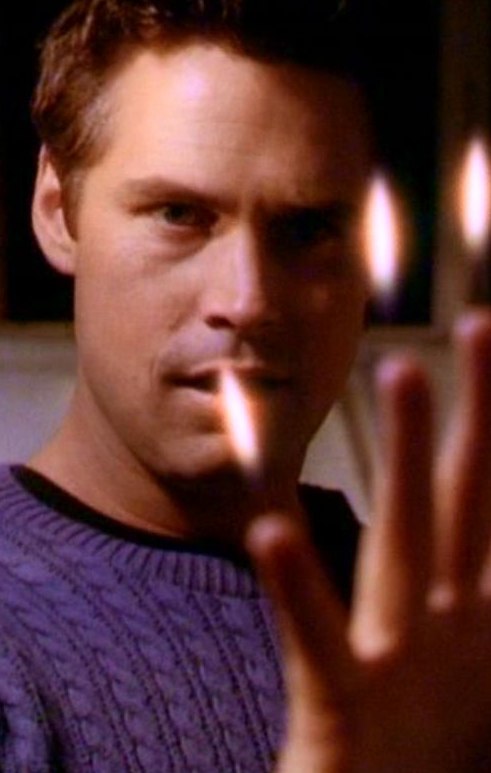
 Edit
Edit